
Frequently asked questions about health and testing at black hill dobermans
Who We Are
Our mission is to preserve and advance the Doberman Pinscher through purpose-driven breeding that prioritizes stable, trainable, and workable temperament, lifelong health, and functional structure. We breed with the understanding that quality of life outweighs quantity alone, selecting dogs who are capable of meaningful work, clear thinking, and sound companionship throughout their lifetime. Our program is rooted in true European type, balancing strength, athleticism, and breed character while making responsible decisions that protect the long-term integrity of the breed.
Health Testing Overview
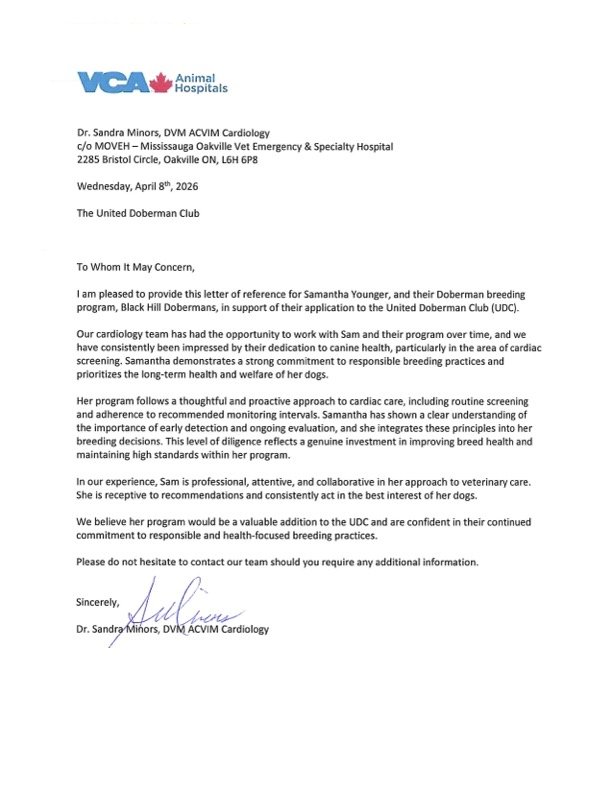
Black Hill follows OFA guidelines and completes comprehensive health testing on our dogs, including cardiac echocardiograms and Holter monitoring, OFA hip and elbow screenings, and DNA testing for thyroid disease and von Willebrand’s disease, along with a full Embark genetic panel. Dogs also receive annual wellness exams and routine bloodwork to monitor liver and kidney function, as well as red and white blood cell counts.
Our dogs OFA Certificates can be found:
https://ofa.org/
Understanding Hip Dysplasia in the Doberman Pinscher
At our kennel, we believe responsible breeding starts with education, transparency, and long-term genetic stewardship. Hip dysplasia is one of many inherited conditions that must be managed thoughtfully within the Doberman Pinscher gene pool.
What Is Hip Dysplasia?
Canine hip dysplasia (CHD) is a developmental orthopedic condition in which the hip joint does not form properly as a dog grows. Over time, this abnormal joint structure can lead to joint instability, arthritis, pain, and reduced mobility.
Hip dysplasia is not present at birth. It develops during growth due to a combination of genetic predisposition and environmental factors.
Is Hip Dysplasia Genetic?
Yes. Hip dysplasia is a heritable condition, but it is polygenic, meaning it is influenced by multiple genes, not a single mutation.
Because of this:
There is no DNA test that can predict hip dysplasia
Two dogs with normal hips can still produce affected offspring
A dog with a less-than-perfect hip score may still carry low genetic risk
Hip dysplasia must be managed at the population level, not judged on individual dogs alone.
How Common Is Hip Dysplasia in Dobermans?
Dobermans are considered a moderate-risk breed for hip dysplasia. While the condition is more prevalent in giant and heavy-boned breeds, hip health remains an important consideration for Dobermans, particularly given their active, working structure.
Because Dobermans are also predisposed to conditions such as DCM and cervical instability, hip dysplasia can be overlooked despite its long-term impact on soundness and quality of life.
Genetics vs Environment
Genetics determine a dog’s baseline risk, while environmental factors influence whether and how that risk is expressed.
Environmental influences include:
Growth rate and body condition
Nutrition and caloric intake
Exercise intensity during development
Good management can reduce the severity of expression, but it cannot override poor genetics.
Hip Testing and What It Means. At Black Hill, we choose OFA for our Hip Testing
OFA (Orthopedic Foundation for Animals)
Performed at 24 months or older
Grades hips as Excellent, Good, Fair, or Dysplastic
Why “Passing Hips” Is Not the Whole Story
Hip dysplasia does not follow simple pass/fail rules.
Dogs with good hip scores may still carry genetic risk
Dogs with fair hips may come from consistently sound families
Over-selecting only “excellent” hips can reduce genetic diversity
Responsible breeders evaluate family history, consistency, and trends over generations, not just individual results.
Our Commitment
Our breeding decisions are guided by:
Health testing
Pedigree analysis
Long-term outcomes in our dogs and their relatives
Responsible population management, not perfection chasing
We believe that improving hip health in the Doberman requires data, honesty, and collaboration within the breed community.
References
Orthopedic Foundation for Animals (OFA) – www.ofa.org
PennHIP Program – www.pennhip.org
Oberbauer, A.M. et al. (2017). The genetics of canine hip dysplasia. Veterinary Journal
Mäki, K. et al. (2002). Genetic trends in canine hip dysplasia. Journal of Animal Science
Understanding DCM in the Doberman Pinscher
Dilated cardiomyopathy (DCM) is the most serious inherited disease affecting the Doberman Pinscher. As breeders, we believe it is essential to communicate accurate, evidence-based information while acknowledging the limits of current science.
What Is DCM?
Dilated cardiomyopathy (DCM) is a disease of the heart muscle in which the heart becomes enlarged and weakened, reducing its ability to pump blood efficiently. Over time, this can lead to arrhythmias, congestive heart failure, or sudden cardiac death.
DCM often develops silently, with no outward symptoms until the disease is advanced.
Is DCM Genetic?
Yes. DCM in Dobermans is inherited, but it is polygenic, meaning it is influenced by multiple genes and complex interactions, not a single mutation.
Important realities of DCM genetics:
There is no single “DCM gene”
No genetic test can definitively predict if a dog will develop DCM
Dogs that test “clear” for known mutations may still develop disease
Dogs with no clinical signs can still pass on risk
DCM is best understood as a risk spectrum, not a yes-or-no condition.
Known Genetic Mutations and Their Limitations
Several genetic variants have been identified in Dobermans (including PDK4 and TTN), but:
These variants do not account for all cases of DCM
Many affected dogs do not carry known mutations
Some dogs with mutations never develop clinical disease
Genetic testing can provide additional context, but it cannot be used
as a stand-alone screening or breeding decision tool.
The Role of Health Testing
Because DCM cannot be predicted genetically, ongoing cardiac screening is critical.
Recommended screening includes:
24-hour Holter monitoring (to detect arrhythmias)
Echocardiography (to assess heart size and function)
Repeated testing over time, as DCM is age-related and progressive
A normal test result reflects the dog’s heart at that point in time only.
Pedigree Matters
While DCM cannot be prevented, pedigree analysis helps breeders:
Identify lines with earlier onset or higher incidence
Track longevity and cause of death
Make informed, balanced breeding decisions
No pedigree is free of DCM — the goal is risk reduction, not elimination.
What DCM Testing Can — and Cannot — Do
Testing CAN:
Detect disease early
Allow for earlier medical management
Provide valuable data for breeding decisions
Improve quality and length of life in some dogs
Testing CANNOT:
Guarantee a dog will not develop DCM
Eliminate genetic risk
Predict sudden cardiac events
Provide certainty for breeding outcomes
Responsible Breeding and DCM
Ethical DCM management focuses on:
Regular, lifetime cardiac screening
Honest disclosure of health information
Avoiding repeated use of lines with consistent early or severe disease
Maintaining genetic diversity while managing risk
Making decisions based on patterns, not fear
Eliminating every dog with a DCM-affected relative would dramatically reduce the gene pool and is not a sustainable solution.
Our Commitment
We are committed to:
Ongoing cardiac testing of our breeding dogs
Tracking health outcomes within our program
Transparency with puppy buyers and fellow breeders
Educating owners on the importance of lifelong heart screening
DCM is a disease no breeder can fully control — only manage responsibly.
Key Takeaways
DCM is genetic, polygenic, and complex
No test can prevent or predict this disease
Health testing reduces uncertainty but does not eliminate risk
Pedigree analysis and transparency are essential
Responsible breeding is about risk management, not guarantees
References
American College of Veterinary Internal Medicine (ACVIM) – Consensus Statements on DCM
Orthopedic Foundation for Animals (OFA) – Cardiac Registry
Meurs, K.M. et al. Genetics of Dilated Cardiomyopathy in Doberman Pinschers
Wess, G. et al. Dilated Cardiomyopathy in Dogs: Pathophysiology and Genetics
Understanding the DCM markers in the doberman Pinscher
What They Tell Us — and What They Do Not
Dilated cardiomyopathy (DCM) is a complex, inherited disease in the Doberman Pinscher. While several genetic markers have been identified, it is critical to understand that no existing marker can predict, prevent, or rule out DCM, particularly in European Doberman populations.
What Are DCM Genetic Markers?
Genetic markers are identified DNA variants that are associated with an increased risk of developing DCM. These markers do not cause disease on their own and do not act in isolation.
DCM in Dobermans is polygenic, meaning it is influenced by multiple genes, modifier genes, and non-genetic factors. As a result, genetic testing provides context, not certainty.
Known DCM Markers in Dobermans
1. PDK4 (Pyruvate Dehydrogenase Kinase 4)
One of the earliest identified DCM-associated variants in Dobermans
Involved in cardiac energy metabolism
Initially described primarily in North American populations
Limitations in European Dobermans:
Many European Dobermans with DCM do not carry the PDK4 variant
Many dogs that carry the variant never develop DCM
The marker alone has poor predictive value
2. TTN (Titin Gene Variant)
Titin is a critical structural protein in heart muscle
Variants in TTN are associated with DCM in both dogs and humans
Limitations:
Not all European Dobermans with DCM carry the TTN variant
Some dogs homozygous for the variant remain asymptomatic
Expression appears influenced by additional genetic and environmental modifiers
Why Markers Are Less Predictive in European Dobermans
European Dobermans differ genetically from North American populations due to:
Different breeding histories
Lower population bottlenecks
Greater genetic diversity in some lines
As a result:
Marker frequency and relevance vary
Disease expression is less tightly correlated to known variants
Reliance on markers alone can lead to false reassurance or unnecessary exclusion
What Genetic Testing Can Be Used For
Genetic marker testing may be used to:
Add one data point to a broader breeding evaluation
Assist in understanding population-level trends
Avoid stacking multiple known risk variants when alternatives exist
Genetic testing should never replace:
Cardiac screening
Pedigree analysis
Long-term outcome tracking
What Genetic Testing Cannot Do
Genetic marker testing cannot:
Predict whether an individual dog will develop DCM
Determine age of onset
Prevent sudden cardiac death
Replace Holter monitoring or echocardiography
Eliminate DCM from a breeding program
Breeding Perspective
No European Doberman bloodline is free of DCM. Responsible breeding focuses on:
Evaluating patterns across pedigrees
Tracking longevity and cause of death
Avoiding repeated use of lines with early or severe expression
Maintaining genetic diversity while managing risk
Transparency with puppy buyers and fellow breeders
DCM management is about risk reduction, not guarantees.
Key Takeaways
DCM in European Dobermans is polygenic and complex
Known genetic markers explain only part of the disease
Marker-negative dogs can still develop DCM
Marker-positive dogs may live normal lives
Health testing and pedigree analysis remain essential
No test can prevent or predict this disease
References
Meurs, K.M. et al.
A splice site mutation in a gene encoding for PDK4 is associated with dilated cardiomyopathy in Doberman Pinschers.
Human Genetics, 2012.Meurs, K.M. et al.
A titin mutation associated with dilated cardiomyopathy in Doberman Pinschers.
Journal of Veterinary Internal Medicine, 2019.Wess, G. et al.
Dilated cardiomyopathy in Doberman Pinschers: Clinical, genetic, and population aspects.
Journal of Veterinary Cardiology, 2010.American College of Veterinary Internal Medicine (ACVIM)
Consensus Statements on Diagnosis and Management of Canine DCM.Orthopedic Foundation for Animals (OFA)
Doberman Pinscher Cardiac Health Registry